Saturday, January 31, 2009

Rent data unfit to publish

Dewi Cooke | the age
January 31, 2009

OFFICIAL government figures on the state of Victoria's rental market have been missing since May and, when they finally are released, are likely to be nine months out of date.

Substandard data collection has been blamed for the long delay in the Office of Housing's quarterly rental report, which last published figures from March.

The Residential Tenancies Bond Authority, a government agency under the auspices of Consumer Affairs Victoria, is responsible for collecting the information and outsourced the task to an Indian-based company, iGate, which has offices in Ballarat.

The data was then passed on to the Office of Housing for analysis but was said to be unusable.

"I was not prepared to publish data that we could not stand by," Housing Minister Richard Wynne said.

The information in the Rental Report is considered a truer indication of the state of the market because the authority records all official rental agreements lodged in the state.

Figures provided by the real estate industry rely on publicly advertised rent or rents reported by agents.

Reports of Melbourne's rental vacancy rate have swung from a tight 1.2 per cent to a healthier 3.9 per cent.

The Office of Housing's December quarter figures are now expected to be published on time in March, while the figures from June and September 2008 will be rolled into one report.

But Opposition Housing spokeswoman Wendy Lovell questioned the delay and said Victorians had been left in the dark about the market.

"You've got to wonder what they are trying to hide." she said.

The Tenants Union of Victoria's Toby Archer said accurate and up-to-date information was "crucial" as the state's rental crisis continued.

A spokeswoman for Consumer Affairs Victoria said data collection for the report had always been outsourced but iGate had been contracted only since July.

"As sometimes happens when moving to a new processing system, a number of teething problems occurred," she said. "These issues have since been resolved."

Grim outlook for real estate jobs

Eli Greenblat | The Age
January 31, 2009

VICTORIA'S real estate industry could start hemorrhaging jobs this year, with a 25 per cent slump in transactions during 2008 forcing suburban offices to cut back.

Real Estate Institute of Victoria chief executive Enzo Raimondo said his recent discussions with members confirmed that the industry was set for a contraction.

"When you have 25 per cent less transactions, you can't have the same number of people dealing with them."

Mr Raimondo said the REIV's corporate membership had remained static at 1900 agencies, but he expected a reduction in the number of individual members.

He said individual REIV memberships had fallen to 6200 from 6500.

"A number of agencies have put off quite a few staff," Mr Raimondo said.

It comes as the REIV's latest report on property prices shows that the Melbourne metropolitan median price for a home fell 0.9 per cent in the December quarter to $426,000. The median price for an apartment eased 1.1 per cent to $365,000.

Annually, the Melbourne property market fell sharply, in line with most asset classes in the grip of the economic crisis, with the median value down 9.7 per cent in 2008.

Wakelin Property Advisory director Monique Wakelin said the bulk of the property sales in the December quarter were in the more affordable suburbs thanks to the recent increase in the first-home buyer's grant.

At the upper end of the property scale, in the leafy expensive suburbs of Melbourne, activity was marked by sellers driven to desperation by depreciating shares and other assets.

"They are not so much dumping their homes, but what they are having to do is sell because they have used a whole heap of equity in their home to gear into the stockmarket.

"It's all the usual high-end suburbs … such as Brighton, Toorak, Kew and Malvern," he said.

Renters face tax hit


Mark Hawthorne | The Age
January 31, 2009

VICTORIAN home renters and small business owners could face hefty stamp duty bills under an amendment to the Duties Act being debated in State Parliament this week.

Proposed amendments to the bill will make some tenants liable for stamp duty if the property they are renting is sold during during their lease.

The stamp duty rate is 5.5 per cent of a property's value, and the changes could lead to stamp duty bills totalling tens of thousands of dollars for renters and business owners.

For example, a person renting a $400,000 flat could be liable for a stamp duty payment of $22,000, and have just 14 days to settle that debt, if the property is sold.

The Duties Amendment Bill 2008 was tabled in Parliament in December following pressure from the State Revenue Office to close loopholes governing the transfer of properties, particularly those owned on 99-year leases, to avoid stamp duty.

Critics have described the changes as a "stealth tax" and say thousands of Victorians will have to pay stamp duty on properties they do not own.

The changes mean:

■The effective reintroduction of lease duties in Victoria, which the State Government abolished in 2001.

■Tenants who pay any consideration other than just rent — for example, hiring a gardener or removing signs from a shop or warehouse — will have to pay stamp duty if the property is sold.

■Property buyers may have to pay double stamp duty — once when contracts are signed, and again on the completion of sale.

■Retirement villages will no longer be exempt, adding tens of thousands of dollars to the cost of buying into a village.

■Stamp duty will have to be paid within 14 days of a contract of sale being signed, rather than within three months of the transaction being completed.

A spokesperson for Treasurer John Lenders said: "Our objective is clear — to close a loophole that allowed people to circumvent tax by deliberately structuring their affairs to take advantage of the abolition of stamp duty on leases.

"The SRO has monitored changes in market practice since the abolition of lease duty and observed that there has been a rise in certain types of leasing arrangements that have exploited the loophole.

"Typically these arrangements are used at the top end of the property market. This legislation will not affect those entering into ordinary commercial leases.

"If it is shown that the bill will have unexpected consequences that are not able to be overcome administratively, then we will consider appropriate amendments to the bill when it is debated in Parliament next month."

Global accounting firm PricewaterhouseCoopers has been among the most vocal of the legislation's critics.

"The legislation was designed to address a particular case that the State Revenue Office lost in the Supreme Court," said Barry Diamond, a partner with PwC.

"In trying to introduce amendments that would close loopholes, there are other consequences that are simply absurd.

"The key message that PwC, along with other key stakeholders, would like get across is that we want the State Government to either withdraw or substantially amend the changes immediately.

"There are a number of consequences of this bill — it introduces a stealth tax, and creates some absurd consequences for people renting a property whereby they could get a stamp duty bill for tens of thousands of dollars."

According to Mr Diamond, the changes will affect those who have a "provision in their lease other than rent".

"This is much more common for commercial leases, where the tennant will have provisions to remove signage from a shop or warehouse.

"If those provisions are in the lease, to pay any consideration other than rent, then they will be liable for stamp duty."

Since the bill was tabled in December, the Government has received complaints from the Law Institute of Victoria, the Property Council, the Tax Institute of Australia and the Australian Bankers Association.

"The real question is: was this the intention of the Government, are they really introducing a tax by stealth?

"Or have they just got it wrong and caught a lot more things in their amendments, like certain long-term leases?" Mr Diamond asked.

Thursday, January 22, 2009

Shared Workspaces


Communication & Co-operation


Communicating with others using various aspects of the World Wide Web has become commonplace. Most of us use e-mail daily, many are members of specialty-group forums, and more and more of us are making and finding friends on web portals such as Facebook and My Space.

Legal and conveyancing professionals have probably not been the quickest to adopt many aspects of the digital world. I recall a story (supposedly true) from my first law firm. The previous decade the managing partner purchased a personal computer for word processing. It was probably among the first in town - he was a very astute man who saw massive potential to this new technology. His assistant promptly resigned stating “I am not going to waste time with some new fad that will be gone in a year”. While this is one exaggerated perspective, as a profession we do tend to regard technology with some resistance.

Property work has at its core a co-operative need between practitioners and lenders, and we achieve that today already using technology. The telephone, facsimile and e-mail now all play a part alongside “snail-mail” as facets of the communication technologies used by us to achieve the result for the client, who is relying on us and her or his lender for the desired result.

Unification


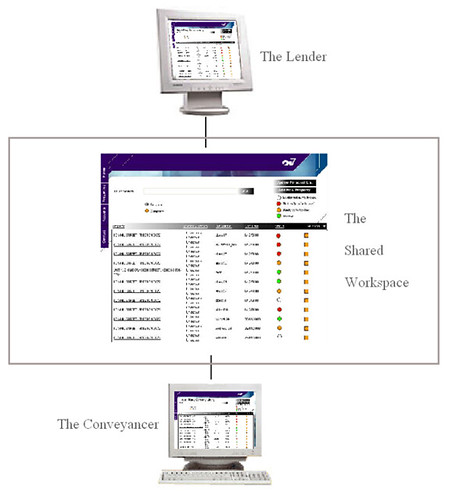
The internet provides the ideal platform for the unification of these separate communication systems. A purpose-designed web platform can create an environment where lenders and conveyancers can communicate in a standardised way, each seeing and receiving what it needs to progress their work.

Instead of a dozen major lenders with a dozen different ways of attempting to obtain their (in essence) identical requirements, a unified web based portal can allow communication that not only saves expenses such as postage, facsimile and telephone - the staff hours able to be saved are immense.

Shared Workspaces


The concept of Shared Workspaces is simple – design a system where the conveyancer can upload documents like contracts and transfers, and the lender can print (or save to its electronic file) those documents instead of writing to the practitioner, or telephoning and then the practitioner mailing or faxing etc. Simply put, it is a web page that is accessible by the conveyancer and lender for that transaction. That web page becomes their “Shared Workspace”.

A method of creating the Shared Workspace is needed, and this should be one where either the lender or the conveyancer can create it, and the system will know when another party is trying to join, and invite them in if appropriate. Couple this to a method of creating (or identifying already open) Shared Workspaces via a single process, and we have the makings of the first real 21st Century advance in the property settlement arena.

Shared Workspaces can combine all of a practitioners matters into a single page, and allow any filewith any lender to be actioned. While Shared Workspaces will allow many things to be achieved, the “killer application” is perhaps the readily identifiable status of a file: A conveyancer can see at a glance whether the lender has joined the Shared Workspace, and when the lender is ready to be booked. Consider the time spent on hold waiting to book a loan advance, only to find out that it is not ready to be booked. Not only has the practitioner lost valuable time, but the lender has wasted their time in taking those calls, and that time would be better spent getting those files ready in the first place! If in future the practitioner could see at a glance that the matter is or is not ready to book, then booking arrangements can only benefit.

With industry support gathering pace, this future is closer than you think.

Contributor Nick Spanninga 2009


Drop in home loans raises fears of higher rents

And there are fears that a drop in investment loans could lead to skyrocketing rents and more homelessness.

Just 5994 new loans were approved in WA in November, the lowest since he same month in 2002 and almost 40 per cent fewer than in May 2006, according to Australian Bureau of Statistics data. It was a fall of 5.8 per cent on October.

The raw data shows just under 5000 were for buying established houses. There were also 2104 refinancings, which are not included in the overall totals.

About $171 million in loans were for building new homes and a further $57 million were for building them. About $1.3 billion was loaned to buy established houses.

Loans for investment housing, which were not broken down by state, fell 7.4 per cent on the previous month and 33 per cent on November 2007.

Housing Industry Association executive Chris Lamont said the investment numbers were of "real concern".

"Unless new measures are implemented... we are going to see more households struggling to afford rental accommodation," he said.

"This is likely to mean an increase in demand for public housing and potentially a further increase in homelessness."

He called for a doubling of the depreciation allowance, incentives for building energy-efficient homes and an expanded national rental affordability scheme.


Meanwhile, the Urban Development Institute of Australia has backed the Housing Industry Association's analysis of other recent housing data by pointing to an expected improvement in new home sales to first home buyers with the tripling of a grant.

HIA WA executive director John Dastlik told WAtoday.com.au last week that there would be a lag between the introduction of the $21,000 grant and its flow-through effect on home sales due to the approvals process in WA.

He was commenting on figures showing new home approvals in the state slumped to an eight-year low in November.


Figures released by the federal government at the weekend showed there had been 279 applications for the grant in WA since October 18, the date it was increased.

But UDIA WA chief executive Debra Goostrey said this was misleading as in WA there needed to be a contract to build before prospective homeowners could apply for the grant, unlike the eastern states where house and land packages from the same company triggered an application much sooner.

UDIA figures showed a "major jump" in land sales from when the grant was announced. The top 12 developers in the state sold 678 lots in the six weeks from October 27, almost 300 more than in the corresponding period before that date.


Author: Chalpat Sonti
Date: January 15, 2009
Publication:  The Age

NAB faces IT losses after Indian fraud

NATIONAL Australia Bank could be forced to write off millions of dollars invested in its offshoring program as a result of the Satyam corporate fraud scandal.

NAB is one of Satyam's biggest customers in Australia and has already made a significant investment on training and transition costs and redundancy payouts as part of its information technology offshoring (ITO) program.

Satyam founder B. Ramalinga Raju last week admitted exaggerating profitability and assets.

Insiders said the bank would face hefty losses if it brought the work back onshore.

"This initial investment was meant to be repaid over the next five years with lower maintenance costs," one source told The Australian. "If NAB breaks out of the ITO wave 1 contract now, there will be large losses of that initial investment which can never be recouped."

Around 90 Satyam staff service NAB, with about 40 per cent based in Australia.

The bank has offshored key technology functions to Satyam, exposing it to significant risk if this service were interrupted.

"It has literally 'bet the bank' with entrusting its key applications to Satyam," a source said.

"Without these applications being successfully supported and maintained, the NAB could not continue to operate."

The Australian understands it will take at least a year for NAB to transfer the work in-house and that the relevant expertise doesn't exist within the bank to service this.

"Most of the staff displaced by ITO wave 1 have been given redundancy packages and long left the NAB" the source said.

"It would take at least 12 months and considerable expense to bring ITO wave 1 applications back in-house."

The bank has a number of contingency plans, spokeswoman Kerrina Lawrence said, and has a core group of internal and external staff capable of performing the work if required.

"NAB's priority is ... seamless service. All business-critical support is performed by NAB's Australian team members."

Qantas is monitoring its relationship with Satyam, as it has more than $US135 million of contracts with Satyam, according to analyst firm IDC.


Mahesh Sharma | January 21, 2009

Article from: The Australian

Wednesday, January 14, 2009

ECV - the last post from the House?

Mrs KRONBERG (Eastern Metropolitan) 


I find that there are serious sinister elements to the e-conveyancing system. Buried in the e-conveyancing system is a grab for cash. It is almost a new kind of taxation on behalf of this government. As a way of herding people like sheep -- there are the ones that get on the truck and the others that run out into pasture -- to use the e-conveyancing system the government has placed an impost on people who refuse to use this electronic device. A price rise has been factored in for people who are buying homes.

On top of the state's stamp duty burden and all of the other costs that are passed on by developers to homebuyers, there is a ratcheting up of some 32 per cent on the price of conveyancing. This corralling is to ensure that users of the old paper-based system are forced to turn to the new electronic system.

How are we to understand this grab for cash in this climate? The dimensions are that the government is set to collect an extra $6 million from the price hike of $15.50 on the 400 000 conveyancing transactions across the state. I think these sorts of burdens are an obscenity. What if you wanted to avoid paying the $15.50 on those transactions? What choice do you have? 


Mr D. DAVIS (Southern Metropolitan) 


I am pleased to be able to make a contribution to the debate on the motion that has been brought to the chamber today by Mr Rich-Phillips, and I compliment him on his timely and balanced motion. It is a motion that does draw openly and directly on the work of the Auditor-General over the recent period. I want to put on the record my compliments to the Auditor-General for the very important series of reports that deal with these areas of ICT (information and communications technology) project implementation by this current Labour government. Nine years into this government and we have an enormous list of projects, and I do not need to detail them all. Mr Rich-Phillips and others have looked at particular details in those projects. But it is important to note that today we do not see the Minister for Information and Communication Technology in the chamber; we see the Acting Minister for Information and Communication Technology, who is trying to get a grip on this portfolio, trying to get a grip on this out-of-touch area of government activity that has cost the community an enormous amount of money.

The motion of Mr Rich-Phillips is timely, balanced and sensible, and points to a major area of government failure over the last nine years. Again I put on record the importance of the Auditor-General's work in forensically ensuring that these matters come to public and parliamentary notice.

My comments today, beyond what I have just said, will be restricted to the electronic conveyancing issues, which I have raised in the Parliament on a number of occasions previously. The Acting Minister for Information and Communication Technology will know that in his other role as Minister for Environment and Climate Change he has responsibility -- and I am sure some days he rues the fact that he has this responsibility -- for electronic conveyancing. To be fair to him, he inherited this white elephant, and I say advisedly it is a white elephant. It is worth putting on record that this project is now tens of millions of dollars -- in all probability more than $40 million -- in the red. It has been mismanaged comprehensively by the department, and there are real questions of probity as to how this process has been undertaken.

I have indicated in the Parliament before that there are serious questions about the involvement of Ajilon, which is indeed a major international contracting company that has, in my view, an unhealthy position in the way it is operating with the Department of Sustainability and Environment. I make the point that Mr Rick Dixon from that firm is sitting in a position where not only is he in a managerial role in the department but he is also involved with the Ajilon firm, which is a successful tenderer to that department as well.

It is hard to think of a more difficult position to be in in terms of avoiding the appearance of a conflict of interest, and it would be hard to avoid the appearance of a conflict of interest in such a situation where you are both in a managerial role and also a contractor for a major contract with that section of the department.

I note that the decisions that have been made by the Council of Australian Governments to move towards an electronic conveyancing system nationally are important. I believe this is the way to go nationally. There are enormous transaction costs that can be reduced by the implementation of a successful electronic conveyancing system that is compatible across jurisdictions. To implement such a system you need to have major buy-in from the stakeholders in the transactions involved inconveyancing -- in this case, hopefully, electronic conveyancing -- and they are the banks particularly, but also building societies and credit unions as well, and solicitors and conveyancers.

The truth of the matter is that this government has not been successful in winning the confidence of the banks in this country, it has not been successful in winning the confidence of the Law Institute of Victoria and solicitors, and there are major concerns about the liabilities that may arise from transactions that occur where there is no satisfactory insurance behind them. The advice to many solicitors is, 'Do not take part in the Victorian system because of the insecurity of your legal indemnities and your insurance support in particular'. That is a major concern. The government has not got these factors right. It is important in implementing these systems to ensure that you have the support of the major players. Ultimately the system will only be used in the way that we would all desire if it does have support across major industry groups.

What is the government's solution to that? It is to belt those who have to pay conveyancing costs across the head.

It says, 'We're going to lift the price of paper conveyancing, although we know that there is only one transaction in Victoria that has occurred as a full electronicconveyance transaction' -- one! -- 'at a cost of $40 million for the project'. What a white elephant, what a disaster, and what a disgrace. The minister now has two hats with which to manage this responsibility -- as Acting Minister for Information and Communication Technology on the one hand and as Minister for Environment and Climate Change on the other. He is now in a position where he can certainly intervene to stop this remarkable merry-go-round of activity where consultants order more work from a consultancy with which they are connected, they grow richer by the day, the money is pumped in by the community and there is no output. One transaction -- $40 million! What a disgrace. The minister should hang his head in shame. Let me just ask the minister how many things he could have used that $40 million for. Health, education or transport? Which of those would have been better to have spent the $40 million on?

Let me now move to the national system. That same group of consultants who have got their grip and their teeth into the department in Victoria -- some might say it in a more prosaic way than I have explained it, and God knows what transactions have transpired outside the department on this matter -- now want to get their teeth into the national system as well. It is a disgrace, and it should be stopped.

The Council of Australian Governments has said we are going to go to a national system, and that is supported. There should be a national e-conveyancing system, as the national newspaper and others have indicated very strongly, but it should be a clean system. It should not be a corrupt system; it should be a system that is seen to be clean, and it should be a system that the community in all states can have confidence in. I, for one, do not have confidence in the system in Victoria, and that is a very sad fact, given the expenditure of more than tens of millions of dollars of community money.


That same group of consultants now want to try to ramp the department up to go into bat at the national level. They now want to get their mitts on the money across the nation. Let me tell you -- and I think some of my federal colleagues have begun to make this point clearly too -- that it is unlikely that the national system will jump at such an offer. I do not think the state governments around the country and the national government are going to be willing to fund at a national level an expansion of a system where only one transaction has been delivered for $40 million.

I think it is worth quoting very briefly the editorial in the Weekend Australian of 12-13 July 2008, and then I will conclude. The heading is 'Nation building' and the subheading is 'Lessons from Victoria's wasted conveyancing efforts'. I will quote several paragraphs from this because I think it is important. It points to the transaction costs that can potentially be saved and the benefits for the national economy. It reads:

The decision of the Council of Australian Governments to build an electronic conveyancing system that spans the nation is by no means glamorous. But history will see it differently.

This is the modern equivalent of the nation-building projects of previous generations. It might not have the cachet of a Snowy Mountains scheme, but just like that great project of the 1950s, electronic conveyancing will benefit all succeeding generations.

Industry groups estimate that if this single initiative is implemented properly, it will cut the cost of buying and selling homes by $250 million a year.

That is not just for one year; it is for next year, the year after that and the year after that. Economic efficiency is about lowering the transaction costs in the economy, and that can be successfully done with an electronic conveyancing system, but not a white elephant like we have got in Victoria. The editorial goes on to say:

The Victorian government appears to have wasted $40 million by building a system that does not comply with the basic requirements of the main players in conveyancing ...

This is the direct result of two mistakes that should be avoided by those who build the national system.

The first mistake was the refusal to accept that conveyancing is primarily a commercial transaction, not a filing procedure for land title bureaucrats.

Those at Land Victoria have a lot to answer for on this. This is a long-term blunder in management of land procedures that should have been done correctly.

The second mistake was to cede control of the system to private consultants.

The Victorian experience shows that those skilled in computer technology are of most value when their role is confined to implementing public policy decisions -- not making them. Responsibility for the national system must remain in the hands of those who are responsible to voters, not shareholders.

To avoid the fate of the ECV --

Electronic Conveyancing Victoria --

the national system should be designed around the business needs of the private sector. By endorsing the principle of a single national system, COAG's working party is off to a flying start.

I agree. It is something that should be supported, but there are traps for young players. In Victoria this Brumby government has fallen deep into the pit.


E-Conveyancing in the House

Mr RICH-PHILLIPS (South Eastern Metropolitan) -- I move:

That this house --

(1) notes with concern the repeated failure of the Bracks and Brumby governments to successfully deliver major ICT projects on time and budget including the ultranet, HealthSMART, the myki ticketing system, Project Rosetta, the criminal justice enhancement project, the housing integrated information program, e-conveyancing and the LEAP database replacement;

(2) notes the loss of ICT expertise in government following the disbandment of the Office of the Chief Information Officer; and

(3) calls on the Minister for Finance, WorkCover and the Transport Accident Commission, as minister responsible for procurement, to develop ICT project management expertise within the Department of Treasury and Finance as a key element of all major government ICT procurement projects.

Information and communications technology (ICT) procurement in the Victorian government sector is now a major industry. The Auditor-General estimated that in 2007 the Victorian government spent $1.5 billion on ICT structure and assets. To put that in context, the government claims for the 2006-07 financial year that its total infrastructure investment was $3.2 billion, so the spend on ICT is approximately 45 per cent of the total amount the government has spent on infrastructure. It is a very significant item of government expenditure, and it is an item of government expenditure that the taxpayers of Victoria can and should expect the government to carry out efficiently and effectively.

Over the last 15 years we have seen major changes in the use of ICT by government. Going back to the previous government, which was a pioneer in introducing ICT to the Victorian government sector, we saw entities like the Parliament of Victoria adopt the use of basic ICT. We saw Parliament introduce a website, the document management system for legislative documents and a whole range of that type of generation 1 ICT projects. Those sorts of projects were introduced across government during that seven-year period.

More recently, under this government, we have seen the trend towards the use of ICT continue, and the projects have become more elaborate, more expensive and more complex. As expected, as you evolve through an ICT framework, the returns on those projects have also diminished. The early, simple projects were easy and had big returns. The projects have since become more complex, and the returns have proportionally diminished.

Notwithstanding that, over that period of time we have also seen Victoria slip behind as a state jurisdiction delivering ICT projects. Through the 1990s Victoria was without doubt the leading jurisdiction in Australia among the states and the commonwealth in the use of ICT for service delivery to its constituency base and the use of ICT among government agencies. Victoria has now lost that leading position to other states and territories that have leapt ahead as Victoria has undertaken a number of significant ICT projects that have failed to deliver on their promises, both in terms of cost outcomes and the time frame in which they were to have been delivered.

The first element of this motion relates to the numerous projects which have not been delivered in accordance with the plans that were put in place for them. I would like to start by running through a few of those projects.

At a number of my colleagues on this side of the house intend to speak at some length on particular projects in their portfolio areas, so I will not dwell on them in any great detail.


......


Electronic Conveyancing


It has been a similar scenario with the electronic conveyancing system, the subject of some comment in this place. I understand the Leader of the Opposition will make some more detailed comments on this later in the debate. The project was announced in 2004 by the then Minister for Planning, Mary Delahunty, who stated in her announcement in March 2004 that:

Land Victoria estimates that if the 400 000 conveyancing transactions that are conducted manually each year are conducted online, the savings in time and paper will amount to more than $100 million a year.
That was the government's target back in 2004 for the e-conveyancing system: it would process 400 000 transactions and it would save $100 million a year. Having spent $40 million implementing the project, the reality has been quite different. Twelve months after the system became available the total number of transactions that have been undertaken is one -- there has been a single transaction using the e-conveyancing system.

The reason the system has not been taken up is that the solicitors involved in conveyancing will not use it, because they have been advised by their professional bodies that they are at risk of professional liability issues if they do so. The banks will not use it for transactions, because they have concerns about the plethora of state-based e-conveyancing systems and would prefer a national system. Again with this project the government failed to create specifications that were acceptable to the end users.

We have spent $40 million on a system that the key parties -- the conveyancers and the banks -- do not want to use and have demonstrated they will not use because it does not meet their requirements.

At a federal level we now have proposals for a national conveyancing system. This throws great doubt on the investment Victoria has made in its e-conveyancing system. It would appear from coverage of the issue that there is limited prospect of the Victorian e-conveyancing system being picked up as the national model. Apparently there is some support from Queensland, but there is limited support across the other jurisdictions. There is every prospect that the $40 million the Victorian government has committed to this project will be wasted because the system did not meet the requirements of the key parties to conveyancing transactions and has simply not been used.

Four years ago the forecast from the then Minister for Planning, Mary Delahunty, was of 400 000 transactions a year, but that has not come to pass because the government did not do its homework on this project.


Ms PENNICUIK (Southern Metropolitan) 


With regard to the e-conveyancing system, notwithstanding whatever problems there may be in terms of its implementation, it seems the biggest problem is that potential users of the system do not want to use it. That is problem no. 1. I note a rather large article in the Australian in May titled 'Revolt against Victorian e-system' that reported that the private players were refusing to engage with it and that:

The Law Council of Australia and the Australian Bankers Association have written ... to the federal government, urging it to have nothing to do with any plan ...

That seems to make e-conveyancing pretty well doomed.


I note Mr Pakula said the matter is now going to the Council of Australian Governments. Perhaps that would have been the best approach from the beginning. The advice and the understanding was that you needed a national system for e-conveyancing, because people are buying and selling properties across state borders. Certainly we should have learnt from 100 years of federation that having six state-based and perhaps two territory-based systems is a recipe for disaster. If one state attempts to implement this system on its own and then expects the country to integrate eight different systems, it is bound to fail. I note that $40 million has been spent on e-conveyancing; that is not a small amount of money, and it certainly could have been better spent on other projects.

SAI Global agrees to buy Espreon

Information services and training company SAI Global Ltd has agreed to buy financial services provider Espreon Ltd for as much as $53.9 million as it aims to diversify its property transaction business.

The announcement follows Espreon's rejection last month of a $42.7 million takeover bid by private investment firm Vectis Group Pty Ltd.

Shares in SAI gained eight cents, or 3.2 per cent, to close at $2.58 and Espreon stock surged 37 per cent, or 13 cents, to 48 cents.

"SAI is a well-respected and innovative corporation with a demonstrated record in the provision of information and transaction services," Espreon chairman Phil Andersonsaid in a statement.

"All of Espreon's key stakeholders, including shareholders, employees and customers, should benefit from SAI's wider network and the ability to access itsextensive resources."

SAI will offer one share for every 4.8 Espreon shares if it attains more than a 50 per cent holding, valuing Espreon at $49.4 million, Sydney-based SAI said.

The offer will be increased to one SAI share for every 4.4 Espreon shares if SAI gains more than 90 per cent of the target. That would value Espreon at $53.9 million.

Before the offer announcement, SAI shares last traded at $2.50 on January 9 and Espreon shares closed at 35 cents on the same day.

The higher offer valued Espreon at 56.8 cents per share, 26 per cent more than Vectis' offer of 45 cents a share.

"The board of Espreon believes the offer represents superior value to shareholders compared with the Vectis takeover bid, providing an opportunity to realise value for their investment at a substantial premium to recent trading prices of Espreon shares," Mr Anderson said.

SAI said it would benefit from the national property business Espreon owns, which will expand SAI's predominantly Victorian operations.

The company also said the takeover would add to profit in the first full year of ownership, and would expand the information services business.

Espreon's board intends to unanimously recommend the offer, which will create a $405 million company, in the absence of a better proposal.

SAI already owns about 20 per cent of Espreon after buying 18.7 million shares for 47 cents each from Hunter Hall Investment Management.

SAI's offer is subject to attaining a minimum 50 per cent of Espreon and no regulatory actions or material transactions taking place.

Espreon recommended on December 22 that shareholders reject the 45 cent per share Vectis bid, which had been raised from the initial 40 cent offer of November 28, describing it as opportunistic and undervaluing the company.

In August, the companies had agreed on a 62 cent takeover bid by Vectis, after the private firm's initial approach in June.

That agreement was terminated on November 6 after the fall in the S&P/ASX 200 Index in September and October triggered a termination clause in the scheme of arrangement.

Reckon Ltd, which develops and sells accounting software including Quicken, also owns about 20 per cent of Espreon.

Tuesday, January 13, 2009

ANZ Bank reviews Satyam links

ANOTHER major local bank is studying the impact of its exposure to Satyam Computer Services' $1 billion corporate scandal.

ANZ Bank has around 100 Satyam contractors who support IT projects. They're mainly based at the bank's Indian subsidiary which employs under 2000 people. 

Last week, the bank told employees that it would develop a contingency plan although its relationship with Satyam was "modest". 

"The relationship involves a number of Satyam staff who support development and testing on information technology projects. This means there is no effect at all on ANZ's day to day IT operations," David Cartwright, ANZ operations, technology and shared services group managing director, said. 

"(As) for the technology development projects that Satyam contract staff are supporting, we are currently assessing key person dependences and developing a plan for how we manage through the situation," Mr Cartwright said. 

"While there is some work to do on this, it's clear that we will be able to take the issues at Satyam in our stride and largely get on with business as usual given the depth of our own IT resources and our relationships with a range of IT vendors globally." 

Unlike other blue-chip companies such as National Australia Bank, Telstra and Qantas, ANZ doesn't have any long-term contracts with Satyam. 

Most local customers are assessing their contractual obligations with Satyam. 

A multi-million-dollar software facility being built on Deakin University's campus in Geelong is also under a cloud as the future of Satyam remains uncertain. 

Satyam's world came to a crushing halt when the company's founder and chairman B. Ramalinga Raju admitted to overinflating the value of cash and bank balances by 50.4 billion rupees ($1.44 billion). 

In scenes out of a Bollywood movie last Friday, Mr Raju, Satyam's former chairman, was arrested with B. Rama Raju, his brother and co-founder, on charges of criminal breach of trust, criminal conspiracy, cheating, falsification of records and forgery. 

Satyam chief financial officer Srinivas Vadlamani was arrested on Saturday. 

The high-profile case has forced the Indian Government to appoint three members to the board of Satyam after it dismissed the incumbent board. 

PricewaterhouseCoppers, which has been auditing Satyam's books for nearly a decade, said it adhered to “applicable auditing standards and (was) supported by appropriate audit evidence”. 

The Australian | Fran Foo | January 12, 2009

Impersonation - Identity theft

Impersonation isn't new. In 1556, a Frenchman was executed for impersonating Martin Guerre and this week hackers impersonated Barack Obama on Twitter. It's not even unique to humans: mockingbirds, Viceroy butterflies, and the mimic octopus all use impersonation as a survival strategy. For people, detecting impersonation is a hard problem for three reasons: we need to verify the identity of people we don't know, we interact with people through "narrow" communications channels like the telephone and Internet, and we want computerized systems to do the verification for us.

Traditional impersonation involves people fooling people. It's still done today: impersonating garbage men to collect tips, impersonating parking lot attendants to collect fees, or impersonating the French president to fool Sarah Palin. Impersonating people like policemen, security guards, and meter readers is a common criminal tactic.

These tricks work because we all regularly interact with people we don't know. No one could successfully impersonate your brother, your best friend, or your boss, because you know them intimately. But a policeman or a parking lot attendant? That's just someone with a badge or a uniform. But badges and ID cards only help if you know how to verify one. Do you know what a valid police ID looks like? Or how to tell a real telephone repairman's badge from a forged one?

Still, it's human nature to trust these credentials. We naturally trust uniforms, even though we know that anyone can wear one. When we visit a Web site, we use the professionalism of the page to judge whether or not it's really legitimate -- never mind that anyone can cut and paste graphics. Watch the next time someone other than law enforcement verifies your ID; most people barely look at it.

Impersonation is even easier over limited communications channels. On the telephone, how can you distinguish someone working at your credit card company from someone trying to steal your account details and login information? On e-mail, how can you distinguish someone from your company's tech support from a hacker trying to break into your network -- or the mayor of Paris from an impersonator? Once in a while someone frees himself from jail by faxing a forged release order to his warden. This is social engineering: impersonating someone convincingly enough to fool the victim.

These days, a lot of identity verification happens with computers. Computers are fast at computation but not very good at judgment, and can be tricked. So people can fool speed cameras by taping a fake license plate over the real one, fingerprint readers with a piece of tape, or automatic face scanners with -- and I'm not making this up -- a photograph of a face held in front of their own. Even the most bored policeman wouldn't fall for any of those tricks.

This is why identity theft is such a big problem today. So much authentication happens online, with only a small amount of information: user ID, password, birth date, Social Security number, and so on. Anyone who gets that information can impersonate you to a computer, which doesn't know any better.

Despite all of these problems, most authentication systems work most of the time. Even something as ridiculous as faxed signatures work, and can be legally binding. But no authentication system is perfect, and impersonation is always possible.

This lack of perfection is okay, though. Security is a trade-off, and any well-designed authentication system balances security with ease of use, customer acceptance, cost, and so on. More authentication isn't always better. Banks make this trade-off when they don't bother authenticating signatures on checks under amounts like $25,000; it's cheaper to deal with fraud after the fact. Web sites make this trade-off when they use simple passwords instead of something more secure, and merchants make this trade-off when they don't bother verifying your signature against your credit card. We make this trade-off when we accept police badges, Best Buy uniforms, and faxed signatures with only a cursory amount of verification.

Good authentication systems also balance false positives against false negatives. Impersonation is just one way these systems can fail; they can also fail to authenticate the real person. An ATM is better off allowing occasional fraud than preventing legitimate account holders access to their money. On the other hand, a false positive in a nuclear launch system is much more dangerous; better to not launch the missiles.

Decentralized authentication systems work better than centralized ones. Open your wallet, and you'll see a variety of physical tokens used to identify you to different people and organizations: your bank, your credit card company, the library, your health club, and your employer, as well as a catch-all driver's license used to identify you in a variety of circumstances. That assortment is actually more secure than a single centralized identity card: each system must be broken individually, and breaking one doesn't give the attacker access to everything. This is one of the reasons that centralized systems like REAL-ID make us less secure.

Finally, any good authentication system uses defense in depth. Since no authentication system is perfect, there need to be other security measures in place if authentication fails. That's why all of a corporation's assets and information isn't available to anyone who can bluff his way into the corporate offices. That is why credit card companies have expert systems analyzing suspicious spending patterns. And it's why identity theft won't be solved by making personal information harder to steal.

We can reduce the risk of impersonation, but it will always be with us; technology cannot "solve" it in any absolute sense. Like any security, the trick is to balance the trade-offs. Too little security, and criminals withdraw money from all our bank accounts. Too much security and when Barack Obama calls to congratulate you on your reelection, you won't believe it's him.

This essay originally appeared in The Wall Street Journal.

by 

Monday, January 12, 2009

Another FSBO Portal: buymyplace.com.au

November 30, 2008 by Emma Sorensen 

buymyplace.com.au is the latest For Sale By Owner (FSBO) portal to hit the market.

buymyplace.com.au is a privately owned company based in Melbourne, and at the moment the portal only covers the state of Victoria.

Currently in beta form, the company plans to hold an Australia-wide launch in early 2009, and have big hopes for the site’s growth, saying:

“Buy My Place is an online real estate advertising company that represents the future of real estate Australia. They provide you with the choice of selling your own home online without the worry of paying high agent commissions.”

“Just as eBay changed the way ordinary people buy and sell goods, Buy My Place will change the way real estate is bought and sold in Australia.”

buymyplace.com.au might look slick, with illustrated cartoon style characters, and well-thought out design, but it’s not the first in the Australian market. It will face competition from existing FSBO portals likeowner.com.ausmartvendor.com.auonthehouse.com.au, and zeroagents.com.au.

Behind the website are a team of industry professionals from real estate, marketing, technology and customer service.

As well as FSBO property listings, market value information, and a customer service team, the website also contains a knowledge centre with resources for owner sellers and buyers alike.

Peter Butterss

 it is a great concept and one that has taken off world wide, indeed we are well aware of the importance of being top of mind for buyers and sellers.
come end of February buymyplace wont be hard to remember!


Friday, January 09, 2009

Telstra, NAB stunned by $1.8b Satyam Computer Services rort

CORPORATE Australia's push to export IT jobs to India is in disarray following a $1.84 billion fraud involving one of the world's key outsourcing companies.

Telstra, Qantas, Coles, National Australia Bank and Suncorp are among scores of Australian companies affected by the scandal. 

The fraud, involving Hyderabad-based Satyam Computer Services, also throws into doubt plans for a $75 million software laboratory at Deakin University's Geelong campus. 

The laboratory, a joint venture between Satyam, Deakin and the State Government, was slated to create 2000 jobs and inject an annual $175 million into the Victorian economy within the next decade. 

Satyam Australia, which employs about 1700 local staff, has headquarters in Collins St. 

Calls to Satyam's Melbourne office yesterday were answered by a recorded message. 

Shares in the Mumbai and New York-listed business crashed after company chairman B Ramalinga Raju, the company's chairman, confessed to falsifying the earnings and assets of India's fourth-largest software and outsourcing services provider. 

Raju's criminal activities surfaced when shareholders blocked his bid to sell two companies to Satyam in order to plug a 50.4 billion rupee ($A1.84 billion) hole in the company's balance sheet. 

Confessing to the crime in a letter to directors, Raju acknowledged that he had inflated company profits over several years. 

Satyam shares slumped 78 per cent in Mumbai trading and in New York its American depositary receipts plunged 90 per cent before the NYSE intervened and halted trading. 

Apart from its Australian clients Satyam provides outsourcing services for the giant Citigroup and Japan's Nissan Motor Corp among other big corporates. 

Worldwide more than 53,000 people are employed by the company, mostly in Bangalore, Chennai and Hyderabad. 

Qantas, which signed a $71 million software development and maintenance contract with Satyam two years ago, said yesterday that if necessary it could activate alternative arrangements. 

An airline spokeswoman said the situation would be monitored daily until resolved. 

She said Qantas could activate alternative internal and external arrangements to ensure a seamless change in contractors. 

Telstra employs Satyam as one of its four major IT contractors. 

Spokesman Martin Barr said the telco was actively reviewing the arrangement and planned to cut the number of contractors to two.

National Australia Bank has outsourced at least 500 positions to India after engaging Satyam and other providers over the past three years.

NAB spokeswoman Kerrina Lawrence said the bank was monitoring events and was reviewing the arrangement with Satyam.

"NAB is closely reviewing the Satyam matter but for the time being the company is continuing to meet its contractual obligations," she said. "NAB has contingency plans in place to ensure continuity of service."

BusinessDaily also learned that a team of Satyam IT consultants from India were deployed last year to work on a technology project at Medibank Private's headquarters in Melbourne.

Medibank spokesman James Connors told said yesterday that there were contingency plans in place if the Satyam staff needed to be flown back to India.

Wesfarmers subsidiary Coles also has Satyam staff working at its Melbourne head office.

"Coles engages only a small number of Satyam employees who help support some legacy systems, and this work has been performed satisfactorily to date," said Coles spokesman Jim Cooper.

"We are obviously aware of the events unfolding with Satyam, and we are having discussions with the company.

"These developments do not pose any significant issues for our business and we will be taking these events into account as we evaluate future IT support requirements."

At Geelong yesterday, Deakin's acting vice-chancellor John Rosenberg declined to write off the software laboratory project.

"At this stage we don't know what is happening and we are still hoping that it can go ahead," Professor Rosenberg said.

Last night, the State Government was in talks with Satyam about saving the jobs of the company's Victorian employees and about the plans the company had for future expansion.


Herald Sun | George Lekakis, Geoff Easdown

January 09, 2009 12:00am

India's Satyam scandal hits local big guns

QANTAS, Telstra and National Australia Bank have been rocked by a major accounting scandal that hit their IT services supplier, Satyam Computer Services, and all have vowed to take action.

A multi-million-dollar facility being built on Deakin University's campus in Geelong is also under a cloud as the future of Satyam remains uncertain.

Australia's largest companies have been caught in the dragnet of corporate fraud at Satyam, where its founder and chairman B. Ramalinga Raju has admitted to overinflating the value of cash and bank balances by 50.4 billion rupees ($1.44 billion).

Satyam Australia is a $200 million company and provides a range of IT-related work to some of the largest corporations in the country.

Its major customers said they were reviewing the situation and some, their contracts, with Satyam locally.

Telstra is in the midst of trimming its IT suppliers from four to two. They include EDS, IBM, Infosys and Satyam.

"We expect to finalise our new arrangements early this year and, obviously, will take the current issues into account," Telstra spokesman Martin Barr said.

NAB spokeswoman Kerrina Lawrence said the bank was closely reviewing the matter, but was quick to add that Satyam has been meeting all its contractual obligations so far.

"We have a contingency plan in place," she said.

Hundreds of NAB technology functions have been sent to India as part of the bank's offshoring campaign -- the main beneficiary being Satyam.

Satyam's contract with NAB expires in 2011, but it is understood that the bank is reviewing its early termination clause.

Qantas has also ensured adequate backup is in place in case Satyam goes under.

Qantas has five years remaining on a seven year contract under which Satyam provides IT application maintenance and support.

Ovum Australia IT analyst Jens Butler believes that any contracts up for renewal with Satyam in the near-term may be at risk of being handed to another provider.

In Victoria, Deakin University acting vice-chancellor John Rosenberg is keeping his fingers crossed that the 10-hectare, eight-year project continues as planned.

The project, in co-operation with the Victorian Government and Geelong City Council, will create at least 2000 new jobs in the Geelong region. If Satyam goes into administration, it is unclear if the Victorian Government would bail out the project.

Satyam declined to comment on the local impact of the scandal but a spokesperson said "it's business as usual".


The Australian | Fran Foo | January 09, 2009

Financial Scandal at Outsourcing Company Rattles a Developing Country

Question. Are any Australian banks outsourcing to Satyam?


NEW DELHI — Ramalinga Raju was contrite, sort of.

In an emotionally charged four-and-a-half page letter, Mr. Raju, the chairman and co-founder of one ofIndia’s largest outsourcing companies, described to his board on Wednesday how a small discrepancy had mushroomed into one of the biggest scandals in Indian corporate history.

“What started as a marginal gap between actual operating profit and the one reflected in the books of accounts continued to grow over the years. It has attained unmanageable proportions as the size of company operations grew,” he wrote. “It was like riding a tiger, not knowing how to get off without being eaten.”

In the end, the scandal threatened to gobble up not just Mr. Raju, who resigned, but his company, Satyam Computer Services. Far beyond Satyam, it raised fears that similar problems might lurk in other Indian companies, particularly in its vaunted outsourcing industry.

“One only hopes that with the kind of scrutiny and the kind of focus this brings, everybody doesn’t end up being painted with the same brush,” said Lakshminarayana, the chief strategy officer for Wipro Technologies, which competes with Satyam.

The long-running fraud, which is being called India’sEnron, also raised questions about the vigilance of regulators in India and the United States.

Satyam serves as the back office for one-third of the Fortune 500, including some of the largest banks, manufacturers, health care and media companies in the world — handling things like computer systems and customer service for companies that include General Electric, Nestlé, Ford MotorCisco and the United States government.

In some cases, Satyam even acted as clients’ outsourced finance and accounting departments.

The fraud will make “people even more nervous about investing” in India and other developing markets, said Jacob Rees-Mogg, the lead manager with Somerset Capital Management, a fund that specializes in emerging markets.

India needs foreign investment more than ever. Though it has enjoyed 9 percent growth a year recently, that is expected to slow to 7 percent, at best, as the global economy cools. Housing prices are down, the country’s major stock index, the Sensex, is half what it was a year ago. And India’s government has little financial leeway for giant stimulus packages like those in China and the United States.

Outsourcing and information technology are crucial parts of the Indian economy. They provided local companies with $64 billion in revenues in 2008 and employed more than two million people directly, and millions more indirectly.

Mr. Raju said he had regularly falsified Satyam’s accounts as the company expanded from a small family-run firm into a back office giant with 53,000 workers in 66 countries.

Some of India’s biggest conglomerates started out as family-run companies, and analysts fear the taint of corruption from Satyam — poor governance, lax accounting controls and a lack of transparency — could sully any of those big companies for investors and customers.

Relatives often hold crucial management positions and sizable stakes in the companies. Foreign investors have begun to push for more outside representation on boards, and for families to give up controlling stakes they hold.

A huge piece of Satyam’s finances was a fantasy. Of the 53.6 billion rupees in cash and bank balances the company listed as assets at the end of its second quarter, 50.4 billion rupees ($1 billion), were nonexistent, according to Mr. Raju’s letter. Revenues for the quarter ended Sept. 30 were actually 20 percent lower than the 27 billion rupees reported, and the company’s profit for the quarter was just 10 percent of what it reported at the time.

Many analysts said it was unthinkable that Mr. Raju had acted without accomplices, and regulators in India, Europe and the United States were likely to take action against Satyam for false accounting. In addition to being listed in India, its shares have traded on the New York Stock Exchange since May 2001, and on Euronext since January 2008.

Satyam’s auditor, PricewaterhouseCoopers, which has audited the company since its NYSE listing, said it was “examining” Mr. Raju’s statement and could not comment further.

Many Satyam clients said they were studying the situation. Cisco said it did not expect any “material impact.”

The revelations could lead to a major shake-up in India’s outsourcing industry, as a nearly cashless Satyam struggles to meet payroll and other expenses. Satyam may be shut down, sold off in its entirety or broken into pieces, they say.

John C. McCarthy, an analyst with Forrester Research in New York, said Satyam’s clients were scrambling to find out “whether the fraud is intermingled” with their operations, and what their liabilities are.

“This happens like clockwork in the high-tech business,” he said. “Every three to four years there’s some financial scandal. It is because high-tech has traditionally been viewed by the financial analysts as a growth industry. There are huge pressures to maintain that growth, and not all companies have the management wherewithal to survive under those pressures.” In the short term, many Satyam clients will migrate to competition like Infosys and TCS, said analysts with Religare Hichens Harrison.

News of the scandal sent the Sensex index down 7 percent on Wednesday. Shares in Satyam fell about 78 percent. Trading in Satyam on the NYSE was suspended until further notice.

Though Mr. Raju’s announcement shocked most of the world, there had been signs for months that something was wrong at the top of Satyam.

The company came under close scrutiny after an October report on Fox News that it had been banned from World Bank contracts when spy software was installed on some computers. Satyam denied the accusation, but in December the World Bank confirmed it had been banned for giving improper benefits to bank staff, and for not accounting for all its fees.

In December, Satyam investors revolted after the company proposed buying two firms with ties to Mr. Raju’s sons.

On Dec. 30, analysts with Forrester Research warned that corporations that relied on Satyam might ultimately need to stop doing business with the company.

“Firms should take the initial steps of reviewing the exit clauses in their current Satyam contracts,” in case management or direction of the company changes, Forrester said.

Four of the company’s directors resigned recently and the company hired Merrill Lynch for strategic advice, a move that is generally a precursor to a sale.

On Wednesday, Merrill Lynch sent a letter to India’s stock exchanges, saying it had terminated its relationship with Satyam after the bank “came to understand that there were material accounting irregularities” at the company. Merrill Lynch officials declined to comment further.

Mr. Raju wrote in his confessional letter that neither he nor the managing director (his brother B. Rama Raju) had “taken one rupee/dollar from the company.” He said the board, his brother and their families had no knowledge of the situation, seeming to leave open the possibility that someone else did.

SEBI, India’s securities regulator, said it would investigate trading in Satyam’s shares. Mr. Raju could face up to 10 years in jail and fines of $5 million in India for the accounting fraud.

NYT Claire Cain Miller contributed reporting from San Francisco.

Australian connections

Satyam specialises in application services outsourcing (for example, Oracle and SAP) and has built a strong customer base in Australia with names like Qantas, Unilever and Coles Myer. The vendor has around 950 consultants servicing the Australian market, with some of those located in Sydney and Melbourne centres and others in their Indian headquarters. Source ZDnet

Tuesday, January 06, 2009

10,000 hours

by 

It's not surprising that Malcolm Gladwell's new book has made a splash. All his thought-provoking writing does and deserves to.

The argument of Outliers:

  • Where you're born and when you're born have an enormous amount to do with whether or not you're successful.
  • Becoming a superstar takes about 10,000 hours of hard work.
  • Both of the bullet points above are far more important than the magical talent myth.

Bill Gates, the Beatles, Beethoven, Bill Joy, Tiger Woods--do the math, 10,000 hours of work.

In some ways, this is a restatement of the Dip. Being the best in the world brings extraordinary benefits, but it's not easy to get there.

For me, though, some of the 10k analysis doesn't hold up. The Doors (or Devo or the Bee Gees) for example, didn't play together for 10,000 hours before they invented a new kind of rock*. If the Doors had encountered significantly more competition for their brand of music, it's not clear that they could have gotten away with succeeding as quickly as they did. Hey, Miley Cyrus wasn't even 10,000 hours awake before she became a hit.

Doc Searls and Scoble didn't blog for 10,000 hours before they became the best, most important bloggers in the world. Molly Katzen didn't work on her recipes for 10,000 hours before she wrote the Moosewood Cookbook either.

*(There were bar bands in Buffalo, where I grew up, that put in far more than 10,000 playing mediocre music... didn't help. Hard work may be necessary, but not sufficient).

Here's my take on it:
You win when you become the best in the world, however 'best' and 'world' are defined by your market. In many mature markets, it takes 10,000 hours of preparation to win because most people give up after 5,000 hours. That's the only magic thing about 10k... it's a hard number to reach, so most people bail.

Yo Yo Ma isn't perfect... he's just better than everyone else. He pushed through the Dip that others chose not to. I'm guessing that there are endeavors (like being CEO of a Fortune 500 company or partner at a big law firm) where the rewards are so huge that the number is closer to 20,000 hours or more to get through the Dip.

But, ready for this? The Dip is much closer in niche areas, new areas, unexplored areas. You can get through the Dip in an online network or with a new kind of music because being seen as the best in that area is easier (at least for now). You can get through the Dip as a real estate broker in a new, growing town a lot quicker than someone in midtown Manhattan. The competition is thinner and probably less motivated.

Yes, it matters where and when you were born. It matters that you get lucky. And it matters most of all that you saw the Dip, realized how far away it was and chose to push through it.

Monday, January 05, 2009

Conveyancing ‘Online in 09’

A colleague came up with this new year resolution

Conveyancing ‘Online in 09’


Saturday, January 03, 2009

Conveyancers threatened with further layoffs

THE bottom has fallen out of the previously lucrative conveyancing industry, with a prediction of more retrenchments nationwide this year.

Australian Institute of Conveyancers president Pauline Barrow said a tightening of bank-lending practices, a reluctance of owners to sell and employment uncertainty by buyers had seen business fall in some instances by up to 40 per cent. Losses varied between states.

In the previously buoyant West Australian property market, conveyancing had experienced up to a 40 per cent drop in 12 to 18months.

Jillian Nelson-Coulon, the institute's WA president, said some businesses had laid off staff and many had shut over Christmas.

In South Australia, transfer lodgements for November had fallen from 5885 in 2007 to 3673 last year, a 38 per cent drop.

The institute's chief executive in South Australia, Geoffrey Adam, said the state's property market was already slowing when the global financial crisis hit.

Ms Barrow said the exception was conveyancing of home and land packages where there had been some respite because of the federal Government's first-home owners' scheme.

Ms Barrow said more retrenchments in the conveying industry were expected in coming months.

Gold Coast solicitor Alison Hiscocks said the number of conveyancing contracts in her sole practice went from up to 50 a month to just 15 settlements.

"I had anticipated we would experience a drop off in conveyancing of about 20 per cent, but in May-June it was like somebody turned the tap off," she said.

"That happened in the space of a month -- that's before people started to talk about it (an economic downturn). I'm not aware of a firm on the Gold Coast which either hasn't put staff off or cut everybody's hours back."

She said that before the increase to the first-home buyers' scheme, business had dropped 40-60 per cent from 12 months before. Now the figure was 30 per cent.

Adelaide-based conveyancer Jeff Stevens said the market in commercial and industrial conveying had also "dropped away", with banks increasing the equity required in property from about 25 per cent to 35 per cent.

Ms Barrow said banks previously had lent up to 110 per cent of valuation in just days; now they took up to a month to finance a purchase.

Additional reporting: Gavin Lower


The Australian Chris Griffith and Debbie Guest | January 03, 2009